Every child deserves a future — make a donation. GIVE NOW

|
|
|
|
|
|
|
|
|
|
|
|
Why MBI. Why Now.​
Science. Powered by Urgency.
Making science deliver its promise at the fastest possible pace.

In the past decades, genomics, immunotherapy, molecular biology, artificial intelligence, and other innovations have transformed medicine.

Yet this progress has not reached children diagnosed with medulloblastoma, a fast-growing and aggressive brain tumor. The standard treatment remains largely based on protocols developed decades ago, and relies on toxic combinations of surgery, radiation, and chemotherapy, potentially associated with lifelong adverse effects. And when medulloblastoma returns, which happens to approximately 30% of patients after initial treatment, the vast majority of these children will die.

The challenge is making scientific progress deliver its promise for these children, at the fastest possible pace.

The Medulloblastoma Initiative (MBI) was created to make that happen.

MBI brings together world-leading scientists, clinicians, institutions, and philanthropists around a shared mission: to accelerate the development of better treatments, and ultimately cures, for children with medulloblastoma.

In only a few years, that mission has already produced measurable results. Laboratories are collaborating across institutions. Scientific discoveries are moving rapidly toward Phase 1 clinical trials that are already treating patients. New therapeutic targets continue to emerge. And a growing international consortium is building the scientific foundation for future therapies.

The MBI Model

A different way fund scientific research

What began as an urgent effort to accelerate research for one child evolved into a different model for organizing and funding scientific research.

The MBI model is built around a simple principle: bring outstanding scientists together around one coordinated scientific strategy, provide the resources that allow them to work collaboratively, and maintain a constant sense of urgency about moving discoveries toward patients.

This approach has attracted attention beyond the medulloblastoma community, including recognition by MIT as an innovative approach to accelerating medical research.

The model rests on several interconnected principles.

PLACEHOLDER

MBI does not distribute scattered grants to unrelated projects.

Each of the laboratories in our consortium contributes specific expertise and addresses a different part of the scientific challenge. Some laboratories study tumor biology and development. Others create experimental models, identify and validate therapeutic targets, develop immunotherapies, or translate discoveries into early clinical trials.

Scientific priorities are considered across the consortium, allowing projects to complement one another and resources to be directed toward a common objective: developing better treatments and cures for medulloblastoma.

Instead of evaluating the impact of each grant only in isolation, MBI considers how the collective portfolio of research fits together and advances the overall scientific strategy.

Collaboration sample graph


At the heart of the MBI model is a simple idea: the world’s leading scientists can accomplish more by working together than by working in isolation
. Participation in MBI depends not only on scientific excellence, but also on a willingness to collaborate.

All knowledge is shared across the consortium. Researchers know what other laboratories are working on, reducing unnecessary duplication and creating opportunities for complementary work.

A model developed in one laboratory can become a resource for others. A therapeutic target identified by one investigator may support development elsewhere. A discovery made by one team can immediately influence the direction of another project.

The value of each discovery therefore extends beyond the laboratory where it originated. Knowledge becomes a shared resource.

Urgency is not simply part of MBI’s history. It is part of its operating philosophy.

MBI was created because a child could not wait for the traditional pace of research. That original urgency has carried through the organization and into the scientific consortium.

Projects are expected to advance toward clear objectives and measurable milestones. Scientific obstacles are addressed quickly. Research with the potential to reach patients is prioritized. The goal is to remove avoidable delays and move promising science toward children as quickly as possible.

For MBI, time is not simply a measure of efficiency: it is what can determine whether a promising discovery reaches the clinic soon enough to matter for children.

MBI places particular emphasis on translational research: moving scientific discoveries from the laboratory toward treatments that can ultimately reach patients.

Basic and foundational research remain essential. But within the MBI ecosystem, particular attention is given to discoveries with the potential to generate therapeutic targets, treatment strategies, and clinical trials.

This translational focus connects the different stages of research around a common objective. Scientific knowledge is not only an end in itself; whenever possible, it becomes the foundation for the next therapeutic opportunity.

Philanthropy makes the MBI model possible.

Instead of funding isolated projects without connection to one another, philanthropic resources can support a coordinated portfolio of research across institutions and across different stages of scientific development.

This provides greater flexibility and continuity, allowing promising work to move forward without every scientific step having to wait for a new and independent funding cycle.

It also allows scientific priorities to be determined according to their potential to advance the overall mission and accelerate treatments for children.

In this model, philanthropy does more than fund research.

Philanthropy connects research, sustains collaboration, reduces fragmentation, and helps turn individual scientific projects into a coordinated effort toward a cure.

“

MBI has demonstrated an extraordinary return on philanthropic investment

In only a few years, donor support has helped build a world-class international research network, generate essential scientific resources, identify new therapeutic possibilities, and move treatments into clinical trials.

The MBI has deliberately concentrated its resources and scientific strategy on one disease: medulloblastoma.

This focus matters.

Rather than dispersing resources across many unrelated diseases and projects, MBI is building a critical mass of scientific expertise, knowledge, infrastructure, and therapeutic development around medulloblastoma. The objective is not simply to advance individual research projects. It is to solve the disease.

At the center of this strategy is translational research, the effort to convert biological discoveries into therapeutic opportunities and ultimately into treatments for patients.

Philanthropic funding has produced tangible results in record time

In less than five years, MBI has established a coordinated international consortium, supported the development of essential research models, helped identify new therapeutic targets, and moved multiple approaches into Phase 1 clinical trials, with additional therapies advancing toward the clinic.

This progress demonstrates what can happen when sustained funding, scientific collaboration, translational focus, and urgency are brought together around a single disease.

Donors are investing in a model that works

The MBI model has demonstrated its ability to convert philanthropic resources into swift and measurable scientific and clinical progress.

Continued investment builds on an established scientific platform, a network of leading researchers and institutions, and a growing portfolio of discoveries and therapeutic approaches.

The MBI was created to solve medulloblastoma. But the principles behind the model, focus, collaboration, coordination, translational research, sustained philanthropic funding, and urgency, have implications beyond a single disease.

The MBI model offers a framework that may be replicated in other rare and underfunded diseases where traditional research structures face similar barriers.

The most valuable return is time

The ultimate return on philanthropic investment cannot be measured only in dollars, publications, or projects funded.

It is measured in time.

For children with medulloblastoma, accelerating progress can determine whether a scientific discovery arrives only for future generations, or soon enough to benefit children living with the disease today.

By concentrating resources, connecting researchers, prioritizing translational science, and maintaining momentum from discovery toward clinical development, philanthropy can shorten the distance between scientific promise and patient benefit.

“

Not accepting it was impossible,
and proving it is possible

From Urgency to Action: The Origin of MBI

Cancer was not new to Fernando Goldsztein, MBI founder, when his eldest son Frederico was diagnosed with medulloblastoma at 9 years of age in 2015.

Fernando himself had successfully battled a serious chondrosarcoma.

Frederico underwent the standard treatment protocol for medulloblastoma, including surgery, radiation, and chemotherapy.

In 2019, Frederico’s tumor relapsed.

Fernando was told that nothing else could be done.

His refusal to accept this reality translated into action when Frederico’s doctor, Dr. Roger J. Packer, one of the world’s foremost authorities on pediatric brain tumors, proposed a different way forward: if better treatments did not yet exist, perhaps the pace of research itself could be accelerated by changing the way research was organized.

Together, they co-designed the Medulloblastoma Initiative and began bringing together leading scientists and institutions around a shared scientific strategy.

The initial funding came from Fernando’s own family. Since then, other philanthropic partners have joined the effort, helping MBI expand its research network and accelerate the development of new therapeutic approaches.

The MBI was therefore born with an inherent sense of urgency. Its origins were deeply personal: an effort to find new options for Frederico. But that urgency quickly became something much larger, a mission to accelerate better treatments and cures for thousands of children around the world facing the same disease.

That sense of urgency remains embedded in the way MBI operates today.

“

The Problem: Why Pediatric Brain Cancer Research Moves Too Slowly

The scientific challenge of curing pediatric brain cancers is enormous. But many of the barriers that slow progress are not scientific at all.

They are financial, organizational, and structural.

4%

Approximately 4% of federal cancer research funding is directed toward childhood cancer, and pediatric brain tumors receive only a fraction of that amount.

The funding gap

Pediatric cancer receives only a small share of overall cancer research funding. Approximately 4% of federal cancer research funding is directed toward childhood cancer , and pediatric brain tumors receive only a fraction of that amount.

Government agencies distribute finite resources across thousands of competing research priorities. Industry, meanwhile, prioritizes therapies that serve larger patient populations for greater commercial returns.

Pediatric cancers often fall between these two worlds: critically important from a medical and human perspective, but difficult to support at the scale required to accelerate progress.

Fragmentation

Limited funding is only part of the problem. How research is organized also slows progress.

Biomedical research often operates in silos. Individual laboratories pursue their own projects, compete for separate grants, and work according to independent funding cycles and institutional priorities.

One laboratory may investigate a biological mechanism while another independently develops an experimental model or therapeutic approach. Without sufficient coordination and collaboration, researchersoften pursue overlapping questions, duplicate work already being done elsewhere, or fail to benefit quickly from discoveries, models, data, and expertise generated by other groups.

Each individual project may be scientifically excellent. But without a coordinated strategy, the collective impact can be less than the sum of its parts.

Researchers also devote substantial time to securing funding for individual projects, and promising work may slow or stop while the next grant is pursued.

The result is fragmentation: excellent science taking place across different institutions but not connected through a common strategy designed to move discoveries toward treatments as quickly as possible.

For children living with aggressive brain cancers, these delays matter.

This led MBI to ask a different question: How can we organize research so that discoveries reach children sooner?

Some Facts About Medulloblastoma

Medulloblastoma is the most common malignant brain cancer in children, with around 400 new cases diagnosed in the US every year and more than 15,000 globally. Nevertheless, it remains a critically underfunded and neglected disease.

Treatment protocols have changed very little since the 1980s; the current global standard of care is over 40 years old. Children with medulloblastoma still rely on highly toxic combinations of surgery, radiation, and chemotherapy administered during key stages of brain development, often resulting in lifelong side effects that severely compromise their quality of life.

The prognosis for relapsed patients is devastating: approximately 30% of children experience recurrence, and for these patients there is no established curative treatment and survival outcomes remain extremely poor. This highlights a critical unmet medical need and underscores the urgency for new therapeutic approaches.

Unlike many other cancers, medulloblastoma has seen limited clinical progress in recent decades, with significant challenges in translating scientific discoveries into effective treatments.

The central barrier is not a lack of scientific potential. It is the difficulty of converting that science into new therapies and early-stage clinical trials capable of bringing innovative treatments to patients.

Inadequate funding, limited coordination, and the lack of integrated translational research have further delayed clinical innovation.

The MBI was created to change this reality: to concentrate resources and scientific expertise on medulloblastoma, accelerate clinical translation, and create new treatment and survival options for children.

400

new cases are diagnosed in
the United States every year.

15,000+

children are diagnosed
globally each year.

40+ years

since the current global standard treatment protocol was established.

No cure

is established for children whose medulloblastoma returns after treatment.

Childhood cancers cannot simply rely on discoveries made in adult oncology. They are biologically different diseases and require their own scientific questions, therapeutic approaches, and research agenda.

“

Scientific Leadership and Oversight

Roger J. Packer, MD

Scientific Lead, The Medulloblastoma Initiative;

Director, Gilbert Family Neurofibromatosis Institute and Brain Tumor Institute, Children’s National Hospital.

Paul A. Northcott Ph.D

Neurologist-in-Chief Emeritus and Chair Emeritus, Department of Neurology, Boston Children’s Hospital;

Bronson Crothers Professor of Neurology, Harvard Medical School.

Scott Pomeroy, MD, PhD

Neurologist-in-Chief Emeritus, Boston Children’s Hospital; Harvard Medical School.

William A. Weiss, MD, PhD

Professor of Neurology, Pediatrics, and Neurological Surgery, UCSF.

The Medulloblastoma Initiative’s scientific strategy is led by Dr. Roger Packer, Director of the Brain Tumor Institute at Children’s National and one of the world’s foremost authorities on pediatric brain tumors.

An external advisory board (EAB) consisting of three renowned researchers monitors the development of research in accordance with ethical and scientific principles and guidelines:

A Network of Leading Scientists and Institutions

The Medulloblastoma Initiative brings together 16 laboratories at leading universities and hospitals across the United States, Canada, and Europe.

All participating investigators are established leaders in their respective fields, have extensive records of scientific achievement; and direct internationally recognized research programs. Scientific governance is therefore reinforced not only through formal oversight, but also through scientific reputation and peer accountability.

When joining the MBI, each lab enters into a formal agreement. Funding is disbursed at each stage as research progresses, and the labs regularly report on the progress achieved with the funding they receive from the MBI.

MBI investigators attend monthly meetings with Dr. Roger J. Packer as Scientific Lead, as well as a semiannual virtual scientific meeting, and an annual in-person scientific meeting in Washington, D.C. Bimonthly scientific progress updates are shared with the entire team.

Accountability, Reporting and Operating Principles

The Medulloblastoma Initiative maintains an ongoing system of communication and accountability with its philanthropic partners.

This includes annual Impact Reports; progress reports issued approximately six months after each Impact Report; regular updates on major scientific advances; and direct communication with donors regarding significant research milestones.

The Initiative also maintains a consolidated financial reporting system that tracks funding allocated to each participating laboratory, active research projects, and future funding commitments.

This formal accountability is reinforced by the operating principles that guide the Initiative: a strong sense of urgency to accelerate the development of new treatments; scientific collaboration and the active sharing of data and expertise among investigators; transparency through the exchange of research findings across the consortium; and a focus on research aimed at curing pediatric medulloblastoma, with particular priority given to projects with the potential to advance toward clinical trials.

Together, these principles and reporting mechanisms help ensure that philanthropic resources remain focused on the Initiative’s central objective: accelerating better treatments and cures for children with medulloblastoma.

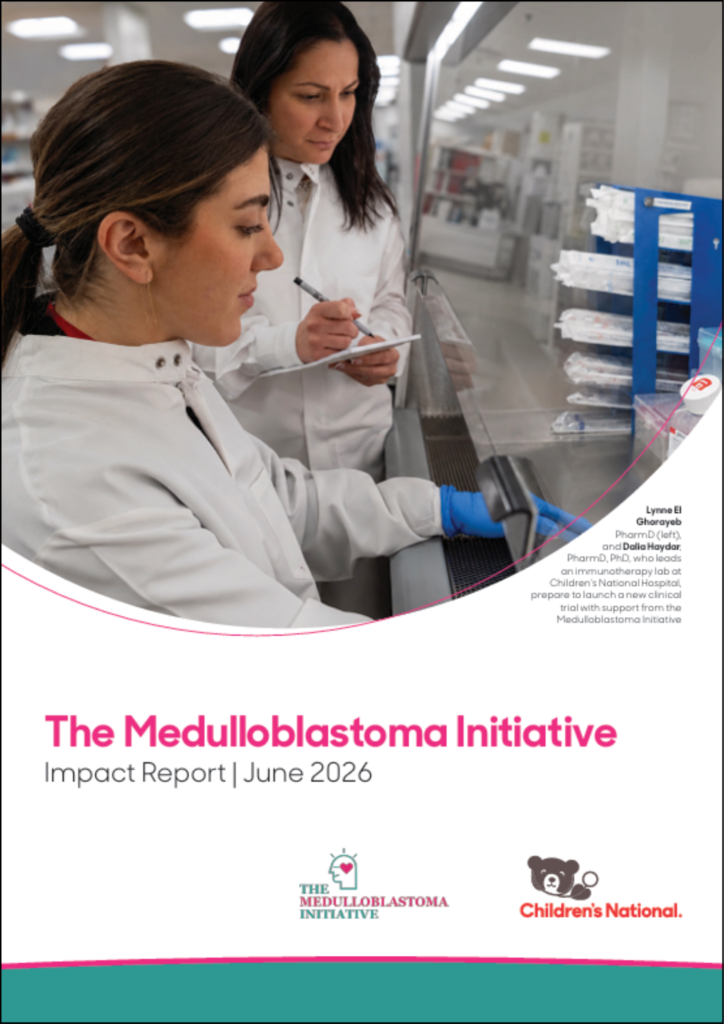
MBI Impact Report - Issued in June 2026